

Boost Efficiency with the Odoo Inventory Module Today!

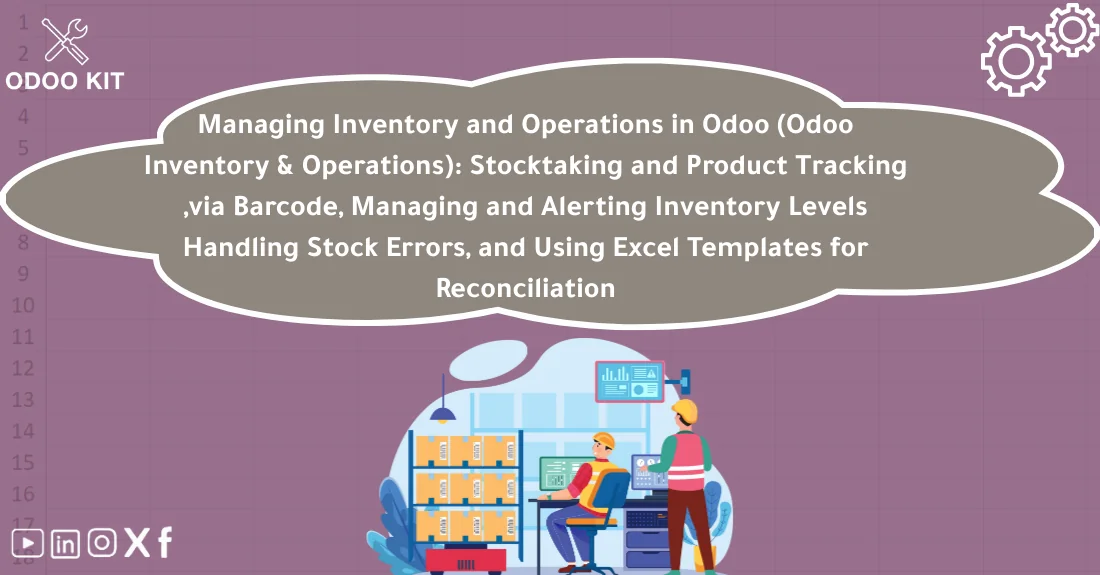
Small and medium-sized businesses and entrepreneurs who want to implement the Odoo ERP system through ready-made, organized packages without technical complexity often face questions about how to standardize inventory processes, control stock costs, and connect operations with purchasing and accounting. This practical guide explains how the Odoo Inventory module works, shows concrete process models and configuration steps, highlights common pitfalls, and provides an actionable checklist to implement inventory and operations management with minimal technical overhead. This article is part of a content cluster that complements our broader coverage on accounting and finance tools for Odoo.
Why this topic matters for SMEs and entrepreneurs
Inventory is frequently the largest current asset on small business balance sheets. Poor inventory management ties up cash, creates stockouts that lose sales, and produces overstock that increases storage and obsolescence costs. For non-technical founders and operations managers, the promise of the Odoo Inventory module is straightforward: a ready-made, configurable package that brings warehouse flows, stock valuation, and automated operations under a single, simple-to-manage interface. This reduces the need for custom development while enabling faster go-live.
Using a packaged approach means you can apply industry-proven workflows (e.g., multi-warehouse picking, FIFO valuation, and drop-shipping) without deep technical skills. It also makes downstream integrations—like with the Odoo Purchases module—and with accounting systems more predictable and repeatable for SMEs looking to scale.
Core concept: What is the Odoo Inventory module?
Definition and components
The Odoo Inventory module is the Odoo ERP component responsible for stock management, warehouse operations, routes, and basic warehouse automation. Core components include:
- Product & variant master data (SKU, barcode, UoM).
- Warehouses and locations (shelves, zones, external providers).
- Routes and rules (replenishment, drop-shipping, cross-docking).
- Inventory adjustments and counting (cycle counts, physical inventories).
- Stock valuation methods (FIFO, Standard Price, Average Cost).
- Automated workflows for receipts, internal moves, and deliveries.
How it connects to other modules
The Inventory module is designed to work seamlessly with procurement, sales, manufacturing, and finance. For example, when a purchase order is validated in the Odoo Purchases module, incoming receipts can automatically create stock moves. Those stock moves then update the financial ledgers if you’re using the Odoo Accounting module, ensuring cost of goods sold and inventory asset accounts are accurate.
Examples of module configuration
Use case: a single-location online retailer. Minimal configuration steps:
- Create products with barcodes and units of measure.
- Set up one warehouse with two locations: Stock and Packing.
- Enable basic routes: Buy > Receive > Stock > Ship.
- Configure inventory valuation to FIFO for accurate cost tracking.
- Schedule weekly cycle counts for top-200 SKUs.
These small steps cover Module Configuration and Process Modeling without custom code—ideal for entrepreneurs who prefer low-complexity packages.
Practical use cases and scenarios for SMEs
1. E‑commerce retailer with seasonal peaks
Challenge: demand spikes during holidays cause stockouts or costly overstock. Solution: configure reordering rules with minimum/maximum levels, enable multi-warehouse if you use 3PL, and run cycle counts weekly for high-turn SKUs. Integrate with shipping and use automated pickings to reduce fulfillment time.
2. Manufacturer with raw materials and finished goods
Challenge: keeping raw materials available for production without excess inventory. Solution: set up routes linking manufacturing to warehouse locations, use Make-to-Order for costly items, and employ expected movements to reserve components automatically. Systems Integration with Odoo for manufacturing planning reduces manual pull requests.
3. Distributor handling returns and quality checks
Challenge: returned items need quarantine and inspection. Solution: create a returned goods location and configure rules for inspection and quality control. Tie in quality management in Odoo to automate quality checks before restocking.
4. Multi-location retail chain
Challenge: balancing inventory across stores. Solution: configure multiple warehouses, inter-location transfers, and automatic replenishment rules. Monitor stock levels with alerts and use the inventory app’s forecasting to prioritize transfers.
Across these scenarios, common operational tools—barcode scanning, batch/lot tracking, and serial numbers—help reduce errors and speed up cycle counts.
Impact on decisions, performance, and outcomes
Implementing the Odoo Inventory module with predefined, ready-made packages typically yields measurable improvements within 3–6 months for SMEs:
- Reduced stockouts: cutoff by 30–70% by using reorder points and safety stock.
- Lower working capital: inventory turns increase by 10–40% depending on prior inefficiencies.
- Fewer operational errors: barcode-driven processes can cut picking/packing errors by 60–90%.
- Faster month-end close: automated stock valuation reduces manual reconciliation time by 50% or more when paired with the Odoo Accounting module.
Operational comfort also improves: teams spend less time on spreadsheets and manual transfers, and managers have centralized visibility for smarter purchasing decisions. For organizations planning Data Migration to Odoo, a staged migration (products & opening stock first, then historical moves) minimizes disruption while delivering value early.
Common mistakes and how to avoid them
Mistake 1: Treating inventory as “set and forget”
Solution: schedule cycle counts, monitor replenishment alerts, and adjust reorder points monthly for changing demand patterns.
Mistake 2: Overcustomizing before stabilizing processes
Solution: start with standard Module Configuration and simple routes. Only add customizations after 3–6 months when process gaps are proven. This avoids expensive rework and aligns with Odoo best practices.
Mistake 3: Poor data quality during migration
Solution: audit SKUs before Data Migration to Odoo. Clean master data (consistent UoMs, correct barcodes), and import opening balances using a controlled template. Consider a dry run to validate expected stock moves.
Mistake 4: Ignoring document flow and approvals
Solution: implement simple rules in Odoo document management for purchase receipts and transfers; require approvals for high-value transfers to reduce losses and mistakes.
Mistake 5: Underestimating integration needs
Solution: plan Systems Integration with Odoo early. Map out connections to e-commerce platforms, 3PL systems, and POS, and address them in the implementation plan so data flows automatically.
Practical, actionable tips and checklist
Use this step-by-step checklist to implement inventory and operations management with minimal technical complexity:
- Inventory discovery (1 week): list top 300 SKUs, current locations, and critical suppliers.
- Choose package & scope (1 week): decide whether you need basic, multi-warehouse, or advanced package (barcode, lots, tracing).
- Module Configuration (1–2 weeks): set warehouses, locations, UoMs, valuation method, and routes.
- Data Migration to Odoo (1–2 weeks): import product masters, opening stock, and suppliers. Run a test import and reconcile totals.
- Process Modeling (1 week): document receipt, QC, putaway, picking, packing, and dispatch workflows. Use simple flowcharts and train staff.
- Integration (1–3 weeks): connect e-commerce, POS, and the inventory and supply chain systems you already use. Prioritize live sales and purchases first.
- Pilot (2–4 weeks): run one warehouse or a subset of SKUs live; collect errors and refine rules.
- Rollout & monitoring (ongoing): expand to full catalog and run weekly monitoring for 90 days.
Practical tips:
- Start with barcode scanning for all inbound and outbound moves to decrease manual entry.
- Keep SKUs simple: use meaningful barcodes and maintain one description per language.
- Use serial numbers for high-value items and lots for perishables to simplify traceability.
- Align purchasing lead times and reorder points—revisit after two demand cycles.
- If you foresee complex integrations or growth, consult about potential Odoo challenges for SMEs early to avoid surprises.
KPIs & success metrics
- Inventory turnover ratio (sales / average inventory) — target: improve by 10–30% in first year.
- Stockout rate (orders delayed due to missing stock) — target: under 2–5% for core SKUs.
- Order fulfillment lead time (time from order to shipment) — target: reduce by 20–50%.
- Picking accuracy rate — target: 99%+ with barcode processes.
- Days sales of inventory (DSI) — target: decrease by 10–25% depending on industry.
- Time spent on month-end stock reconciliation — target: reduce by 40–70% when integrated with the Odoo Accounting module.
- Percentage of automated stock moves vs manual adjustments — target: >85% automated.
FAQ
How do I migrate existing stock balances into Odoo without disrupting operations?
Plan a staged Data Migration to Odoo: export master data and opening balances, perform a test import in a sandbox, and reconcile totals. Choose a low-activity window for the live cutover (e.g., weekend). Keep the previous system read-only after the cutover until you validate first live transactions.
Can I use Odoo Inventory without technical staff?
Yes. The standard Odoo Inventory module is designed to be configurable through the UI. For SMEs using ready-made packages, the recommended approach is to follow a predefined Module Configuration checklist and use training materials for staff. Use a managed package from odookit to reduce technical complexity further.
How does Odoo handle lot/serial tracing and recalls?
Odoo supports both lot and serial number tracking. Configure products to require lot/serial numbers and use quality checks to enforce inspection before release. This enables fast recalls by filtering stock moves by lot and exporting the associated partners and orders.
What integration points should I prioritize?
Prioritize integration with sales channels (e-commerce, POS), purchasing (via the Odoo Purchases module), and accounting ledgers. If you use third-party logistics, connect those systems next. Consider future capabilities like AI in Odoo operations for forecasting and smarter replenishment.
Next steps — Try a ready-made package with odookit
If you want a low-complexity path to better inventory control, consider starting with an odookit packaged implementation: preconfigured warehouses, routes, barcode flows, and a migration template for your opening balances. A typical small business goes live in 4–6 weeks with guided setup and training. Start by mapping your top 200 SKUs and request a tailored package demo from odookit to see how standard Module Configuration and Process Modeling can be applied to your operations.
Reference pillar article
This article is part of a content cluster tied to our in-depth financial guide — read the pillar article: The Ultimate Guide: Odoo for accounting and finance – core modules, comparison with Excel, and how ODOO KIT tools help with audits.
Further operational notes
Two additional operational areas to check during implementation:
- Address common Odoo inventory issues early—misconfigured locations or valuation settings are frequent culprits.
- Document your processes and store them in a central place; tie in Odoo document management so staff can access SOPs and work instructions during shifts.